Documentation
Jeeves Watcher 🎩
Filesystem watcher that keeps a Qdrant vector store in sync with document changes.
Overview
jeeves-watcher monitors a configured set of directories for file changes, extracts text content, generates embeddings, and maintains a synchronized Qdrant vector store for semantic search. It automatically:
- Watches directories for file additions, modifications, and deletions
- Extracts text from various formats (Markdown, PDF, DOCX, HTML, JSON, plain text)
- Chunks large documents for optimal embedding
- Embeds content using configurable providers (Google Gemini, mock for testing)
- Syncs to Qdrant for fast semantic search
- Enriches metadata via rules and API endpoints
- Indexes source documents (v0.20.0+): records that live in another system, retrieved by HTTP callback when the owner notifies the watcher (
POST /documents)
Source Documents and the SDK
Besides files, the watcher can index records owned by another application (chat threads, tickets, database rows). The application notifies the watcher with a reference such as app://chat/thread/<id> and a designated inference rule; the watcher calls back to a URL configured under sources, renders the JSON record with the rule, embeds it and keeps its points in sync. The watcher keeps no copy of the record. See the Source Documents guide.
@karmaniverous/jeeves-watcher-sdk is a typed TypeScript client for the application-facing API (search, scan, render, metadata, reindex, issues, document notify/delete). When the API is exposed beyond localhost, protect it with api.apiKey (Authentication).
Architecture
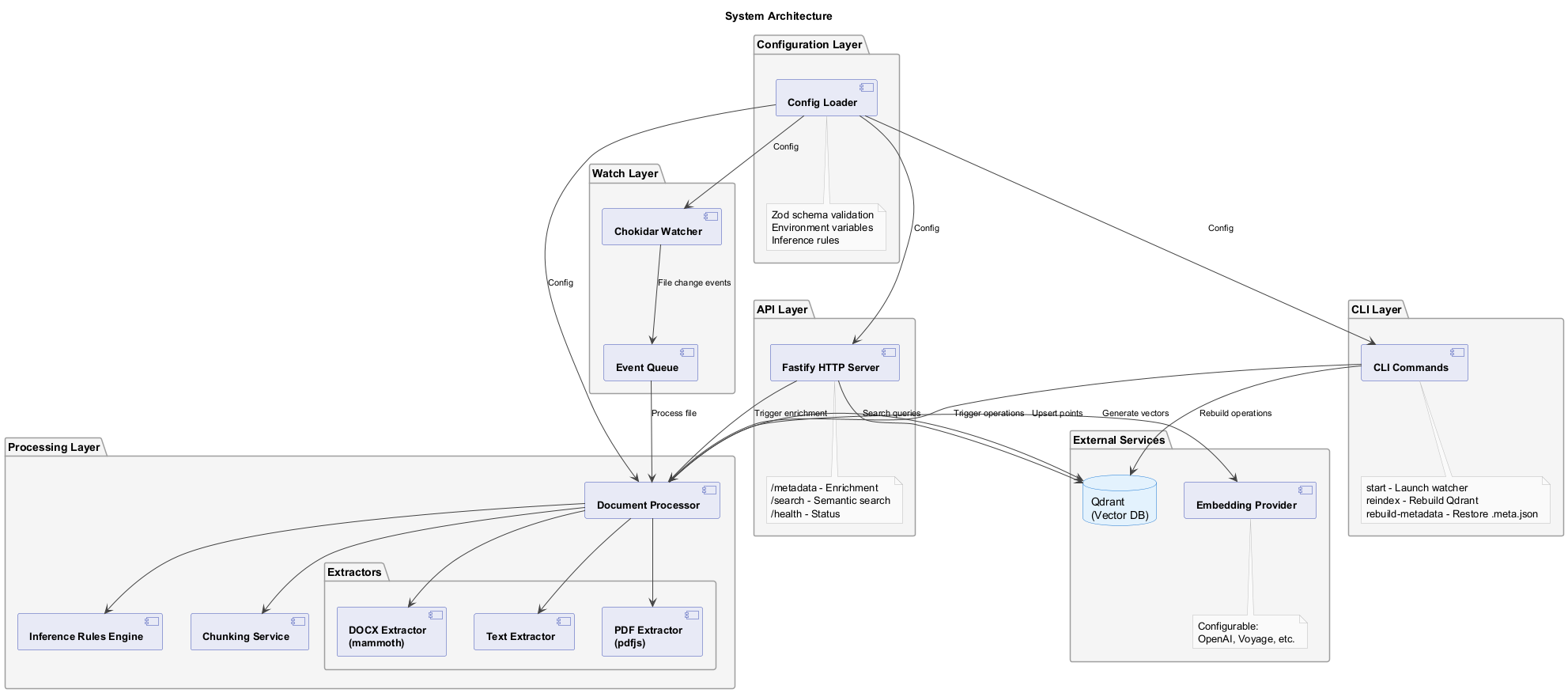
For detailed architecture documentation, see packages/service/guides/architecture.md.
Prerequisites
- Node.js >=22.13
- Qdrant must be running and reachable before starting jeeves-watcher. The Qdrant collection is created automatically on first startup — no manual collection creation required.
Quick Start
Installation
npm install -g @karmaniverous/jeeves-watcher
Initialize Configuration
Create a new configuration file in your project:
jeeves-watcher init -o ./config
-o names the output directory; this writes ./config/config.json with sensible defaults (an existing file is left untouched). The template sets embedding.dimensions to 768; with Gemini (gemini-embedding-001 returns 3072-dimensional vectors) change it to 3072 before the first start.
Configure
Edit ./config/config.json to specify:
- Watch paths: Directories to monitor
- Embedding provider: Google Gemini or mock (for testing)
- Qdrant connection: URL and collection name
- Inference rules: Automatic metadata enrichment based on file patterns
Example minimal configuration:
{
"watch": {
"paths": ["./docs"],
"ignored": ["**/node_modules/**", "**/.git/**"]
},
"embedding": {
"provider": "gemini",
"model": "gemini-embedding-001",
"apiKey": "${GOOGLE_API_KEY}"
},
"vectorStore": {
"url": "http://localhost:6333",
"collectionName": "my_docs"
}
}
Start Watching
jeeves-watcher start -c ./config/config.json
The watcher will:
- Index all existing files in watched directories
- Monitor for changes
- Update Qdrant automatically
CLI Commands
| Command | Description |
|---|---|
jeeves-watcher start -c <path> |
Start the filesystem watcher (foreground) |
jeeves-watcher init -o <dir> |
Write a default config.json into <dir> (pass -o: without it the command fails) |
jeeves-watcher status |
Probe service health and version (GET /status) |
jeeves-watcher reindex |
Trigger a scoped reindex (default rules) |
jeeves-watcher rebuild-metadata |
Rebuild the enrichment store from Qdrant payloads |
jeeves-watcher search <query> |
Search the vector store |
jeeves-watcher enrich <path> |
Enrich document metadata with key-value pairs |
jeeves-watcher config validate -c <path> |
Validate a config file against the schema |
jeeves-watcher service <action> |
Manage the watcher as a system service (install, uninstall, start, stop, restart, status) |
jeeves-watcher scan |
Scan the vector store with filter-only queries |
jeeves-watcher config [jsonpath] |
Query the effective config via JSONPath |
jeeves-watcher issues |
Show indexing issues and errors |
jeeves-watcher helpers |
Show loaded map and template helpers |
jeeves-watcher config apply [-f <file>] [--replace] |
Merge a config patch (file or stdin) into the running service's config, validate, write and reload |
The API commands (search, enrich, scan, reindex, rebuild-metadata, issues, helpers, config, config apply) accept --api-key (default: the JEEVES_WATCHER_API_KEY environment variable); their HTTP errors print HTTP <status> <code>: <message> (a 401 prints key guidance instead). See the CLI Reference.
Configuration
Environment Variable Substitution
Config strings support ${VAR_NAME} syntax for environment variable injection:
{
"embedding": {
"apiKey": "${GOOGLE_API_KEY}"
}
}
If GOOGLE_API_KEY is set in the environment, the value is substituted at config load time. Set templates in inference rules use Handlebars {{...}} syntax (e.g. {{frontmatter.title}}), which is distinct from the ${...} environment variable syntax used in config values like embedding.apiKey.
Watch Paths
{
"watch": {
"paths": ["./docs", "./notes"],
"ignored": ["**/node_modules/**", "**/*.tmp"]
}
}
paths: Array of glob patterns or directories to watchignored: Array of patterns to excluderespectGitignore: (default:true) Skip processing files ignored by.gitignorein git repositories. Nested.gitignorefiles are respected within their subtree.moveDetection: (optional) Correlate unlink+add events as file moves to avoid re-embedding.enabled(default:true),bufferMs(default:2000) — how long to buffer unlink events before treating as deletes.
Embedding Provider
Google Gemini
{
"embedding": {
"provider": "gemini",
"model": "gemini-embedding-001",
"apiKey": "${GOOGLE_API_KEY}"
}
}
Vector Store
{
"vectorStore": {
"url": "http://localhost:6333",
"collectionName": "my_collection"
}
}
Inference Rules
Automatically enrich metadata based on file patterns using declarative JSON Schemas:
{
"schemas": {
"base": {
"type": "object",
"properties": {
"domain": {
"type": "string",
"description": "Content domain"
}
}
}
},
"inferenceRules": [
{
"name": "meeting-classifier",
"description": "Classify files under meetings directory",
"match": {
"properties": {
"file": {
"type": "object",
"properties": {
"path": { "type": "string", "glob": "**/meetings/**" }
}
}
}
},
"schema": [
"base",
{
"properties": {
"domain": { "set": "meetings" },
"category": { "type": "string", "set": "notes" }
}
}
]
}
]
}
Inference rules use schema arrays that reference global named schemas. Type coercion automatically converts string interpolation results to declared types (integer, number, boolean, array, object). See Inference Rules Guide for details.
Chunking
Chunking settings are configured under embedding:
{
"embedding": {
"chunkSize": 1000,
"chunkOverlap": 200
}
}
Enrichment Store
Enrichment metadata (from POST /metadata or watcher_enrich) is stored in a SQLite database at <stateDir>/enrichments.sqlite, using Node's built-in node:sqlite module (no native addon). Enrichments survive full reindexes. Composable merge: scalar fields overwrite, array fields union+deduplicate with inference rule output.
{
"stateDir": ".jeeves-metadata"
}
API Endpoints
The watcher provides a REST API (default port: 1936):
| Endpoint | Method | Description |
|---|---|---|
/status |
GET | Health check, uptime, collection (name, point count, dimensions), reindex and initial-scan state |
/search |
POST | Semantic search ({ query: string, limit?: number, offset?: number, filter?: object }; unknown keys are rejected) |
/render |
POST | Render a document through inference rules ({ path } or { source }) (v0.8.0+) |
/search/facets |
GET | Schema-derived search facet definitions with live values (v0.8.0+) |
/metadata |
POST | Update document metadata with schema validation ({ path | source, metadata: object }) |
/documents |
POST | Notify changed source documents ({ documents: [{ source, rule }] }); 202, or per-document results with ?wait=true (v0.20.0+) |
/documents/delete |
POST | Delete source documents ({ sources } (at most 1000) or { filter }; never deletes file points) (v0.20.0+) |
/reindex |
POST | Scoped reindex with blast area plan (issues, rules, full, path, prune + dryRun). path accepts string | string[]; scope path also accepts source references. |
/rebuild-metadata |
POST | Rebuild the enrichment store from Qdrant payloads (file points only; system fields are not copied) |
/config |
GET | Merged config document (public keys only: never api, sources, embedding or vectorStore) with rule values, helpers and issues; optional ?path=<jsonpath> filter. Rules include source attribution. |
/config/schema |
GET | JSON Schema of merged virtual document (v0.5.0+) |
/walk |
POST | Filesystem walk with glob intersection ({ globs: string[] }). Returns { paths, matchedCount, scannedRoots }. |
/config/match |
POST | Test paths against inference rules ({ paths: string[] }) (v0.5.0+) |
/issues |
GET | Current embedding failures and processing errors (v0.5.0+) |
/rules/register |
POST | Register virtual inference rules from an external source |
/rules/unregister |
DELETE | Remove all virtual rules from a source ({ source }) |
/rules/unregister/:source |
DELETE | Remove all virtual rules from a named source |
/scan |
POST | Filter-only point query with cursor pagination ({ filter, limit?, cursor?, fields?, countOnly? }) |
/config/validate |
POST | Validate a configuration without applying ({ config?, testPaths? }) |
/config/apply |
POST | Merge a patch, validate, write, and reload configuration ({ patch, replace? }; config is an alias of patch). The echoed config is redacted like GET /config. |
/rules/reapply |
POST | Re-apply inference rules to files matching globs ({ globs }) |
/points/delete |
POST | Delete points matching a Qdrant filter ({ filter }) |
/vcs/* |
GET/POST | Version control: status, history, show, diff, check-exclusion, revert, exclude (see the Version Control guide) |
Errors carry { error, code, message?, details? }; the HTTP status follows from code, with one exception: a prune reindex without a vector store answers 400 not_available (see Error Handling).
Example: Search
curl -X POST http://localhost:1936/search \
-H "Content-Type: application/json" \
-d '{"query": "machine learning algorithms", "limit": 5}'
Example: Search With Filter
curl -X POST http://localhost:1936/search \
-H "Content-Type: application/json" \
-d '{
"query": "error handling",
"limit": 10,
"filter": {
"must": [{ "key": "domain", "match": { "value": "backend" } }]
}
}'
Example: Update Metadata
curl -X POST http://localhost:1936/metadata \
-H "Content-Type: application/json" \
-d '{
"path": "/path/to/document.md",
"metadata": {
"priority": "high",
"category": "research"
}
}'
OpenClaw Plugin
This repo includes an OpenClaw plugin (packages/openclaw) that exposes the jeeves-watcher API as native agent tools:
| Tool | Description |
|---|---|
watcher_status |
Service health, version and uptime |
watcher_service |
Manage the system service (install, uninstall, start, stop, restart, status) |
watcher_search |
Semantic search across indexed documents |
watcher_enrich |
Set or update document metadata |
watcher_config |
Query the effective runtime config via JSONPath |
watcher_walk |
List watched files matching globs |
watcher_validate |
Validate a candidate config, optionally testing file paths |
watcher_config_apply |
Apply a config patch (response config redacted) |
watcher_reindex |
Trigger a scoped reindex with blast area plan |
watcher_scan |
Filter-only point query with cursor pagination |
watcher_issues |
List processing issues (file paths and source references) |
watcher_vcs_status |
Version tracking state for every root |
watcher_vcs_history |
Change history by path or glob, optional date range |
watcher_vcs_show |
File content at a specific version |
watcher_vcs_diff |
Changes between two versions, or a version and current |
watcher_vcs_revert |
Restore files from a historical version |
watcher_vcs_exclude |
Exclude or re-include paths from version tracking |
watcher_vcs_check |
Whether a path is excluded from version tracking, and why |
The plugin is a standard OpenClaw plugin on @karmaniverous/jeeves 0.7 core, installed by jeeves install. It writes no workspace files; its always-in-context watcher rules are injected via the before_prompt_build hook. See the OpenClaw Integration Guide for details.
Plugin configuration supports apiUrl (defaults to http://127.0.0.1:1936), an optional apiKey (sent as a bearer token when the service sets api.apiKey; env fallback JEEVES_WATCHER_API_KEY) and configRoot (no default: set it in plugin config or via JEEVES_CONFIG_ROOT; resolved lazily, so the plugin registers before it is set).
Supported File Formats
- Markdown (
.md,.markdown) — with YAML frontmatter support - PDF (
.pdf) — text extraction - DOCX (
.docx) — Microsoft Word documents - HTML (
.html,.htm) — content extraction (scripts/styles removed) - JSON (
.json) — with smart text field detection - Plain Text (
.txt,.text)
Any other extension is read as plain text.
License
BSD-3-Clause
Built for you with ❤️ on Bali by Jason Williscroft & Jeeves.