Architecture
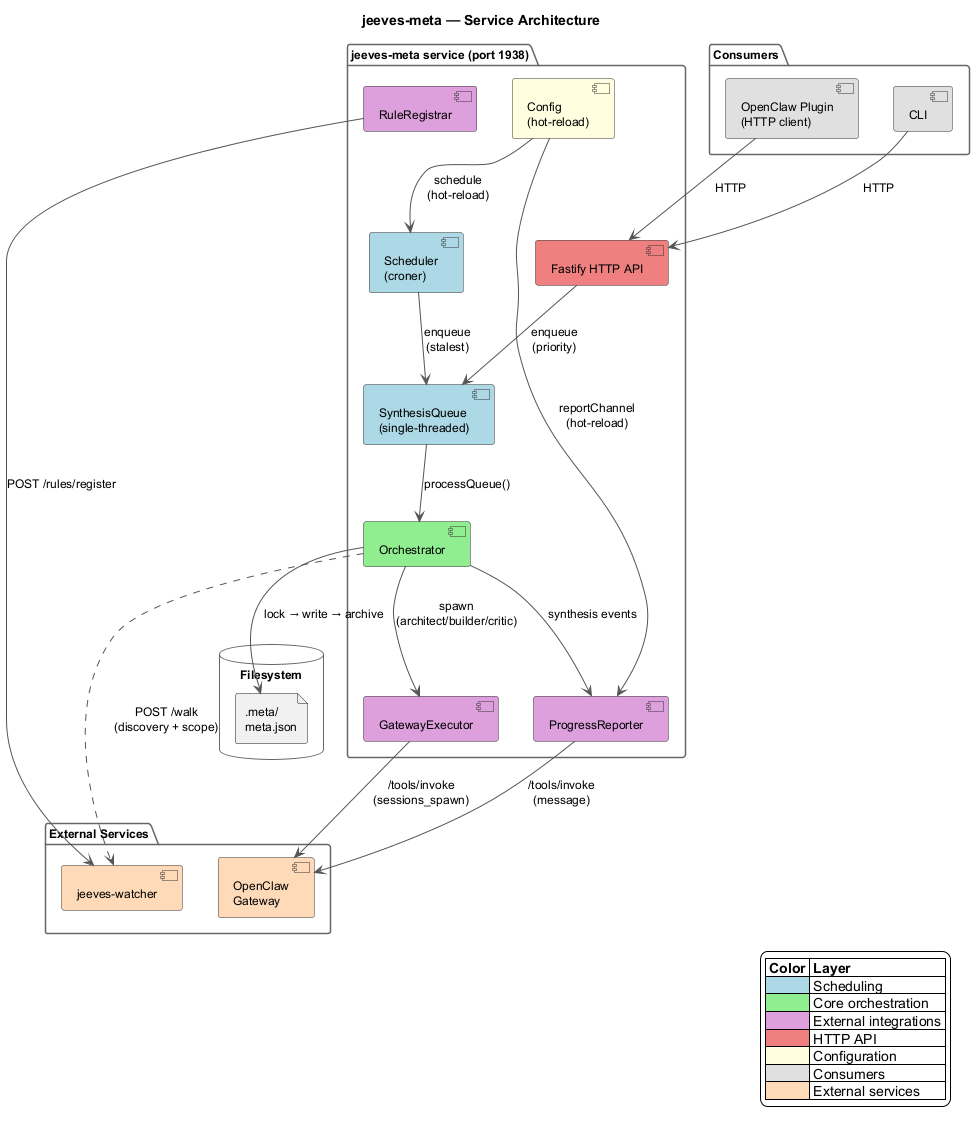
Components
| Component | Responsibility |
|---|---|
Scheduler |
Croner-based cron, discovers stalest candidate, enqueues work |
SynthesisQueue |
Three-layer queue (current + overrides + automatic) with deduplication |
GatewayExecutor |
Spawns LLM sessions via gateway /tools/invoke, polls for completion |
ProgressReporter |
Sends synthesis events to a channel via gateway /tools/invoke → message tool |
RuleRegistrar |
Registers 2 virtual inference rules with watcher at startup |
HttpWatcherClient |
Watcher HTTP client with 3-retry exponential backoff and connection timeout protection |
| Fastify server | 13 HTTP endpoints across 10 route modules |
| Config hot-reload | fs.watchFile monitors config; hot-reloadable fields applied immediately, restart-required fields warn on change |
| Shutdown handlers | SIGTERM/SIGINT → stop scheduler → release lock → close server |
Service Architecture
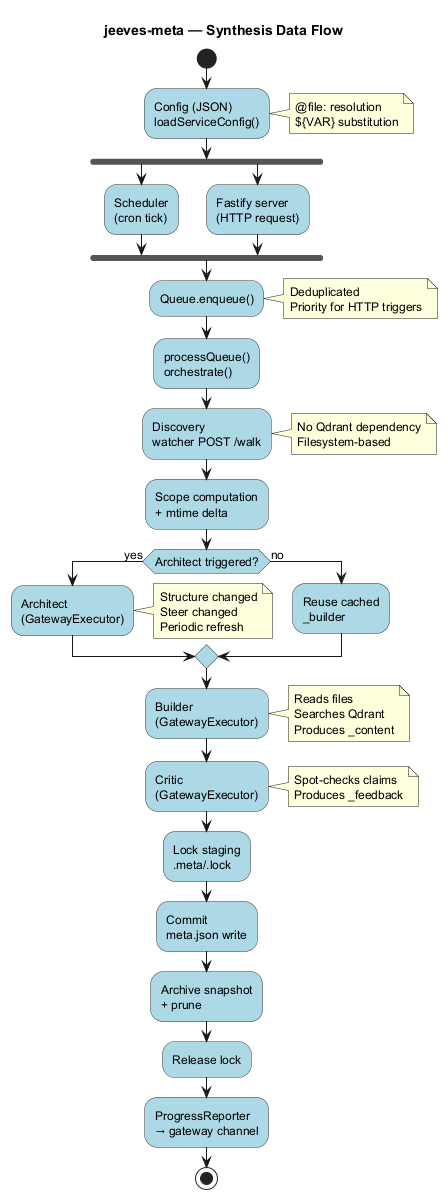
Data Flow
Discovery
The discoverMetas() function enumerates all .meta/meta.json files via the watcher's POST /walk endpoint (no Qdrant dependency). Paths are deduplicated by .meta/ directory.
The buildOwnershipTree() function constructs the parent/child hierarchy:
- Sort all meta paths by owner path length (shallowest first)
- For each node, find the closest ancestor meta (longest owner path match)
- Set
treeDepth = parentDepth + 1; record bidirectional parent/child pointers
A lightweight variant, buildMinimalNode(), creates a shallow tree (self + direct children only) for targeted synthesis — avoiding full-tree cost when a specific path is requested.
Scope Filtering
A meta owns its parent directory and all descendants, except subtrees that contain their own .meta/. Child .meta/meta.json files ARE included as rollup inputs.
getDeltaFiles() filters scope files locally by mtime since _generatedAt. On first run (no _generatedAt), all scope files are returned.
Auto-Seed
The autoSeedPass() function is executed at the start of each scheduler tick (before discovery). It processes configured autoSeed rules:
- For each rule, walk the watcher with the rule's
matchglob - Extract candidate directories (with optional
parentDepthwalking) - Build a map of owner path → effective options (last match wins for all fields including timeouts)
- Filter out paths that already have a
.meta/directory - Create
.meta/meta.jsonfor each new candidate with the matched rule'ssteer,crossRefs, and timeout overrides
Virtual Rules
Two inference rules are registered with jeeves-watcher:
| Rule | Matches | Purpose |
|---|---|---|
meta-current |
**/.meta/meta.json |
Index live synthesis with domain tags + extracted fields |
meta-archive |
**/.meta/archive/*.json |
Index archived snapshots |
Config Hot-Reload
The service monitors its config file via fs.watchFile. Fields are divided into two categories:
Restart-required (warn on change, no live effect): port, watcherUrl, gatewayUrl, gatewayApiKey, defaultArchitect, defaultCritic.
Hot-reloadable (applied immediately): schedule (cron reschedule), logging.level (Pino level change), and all remaining fields (reportChannel, reportTarget, serverBaseUrl, watcherHealthIntervalMs, tier2ScanLimit, autoSeed, architectEvery, depthWeight, maxArchive, maxLines, thinking, skipUnchanged, metaProperty, metaArchiveProperty).
Phase-State Machine
The src/phaseState/ module implements the per-meta phase-state machine:
| Module | Responsibility |
|---|---|
derivePhaseState.ts |
Reconstruct _phaseState from legacy fields for backward compatibility |
invalidate.ts |
Detect structural/steer/cross-ref changes and mark phases as stale |
phaseTransitions.ts |
Pure functions for all state transitions (invalidation, success, failure, retry) |
phaseScheduler.ts |
Corpus-wide candidate selection: critic > builder > architect, staleness tiebreak |
Two-Tier Scheduler
The src/scheduler/ module provides the croner-based tick driver. The src/scheduling/ module provides staleness computation:
| Module | Responsibility |
|---|---|
scheduler/index.ts |
Croner cron, adaptive backoff, per-tick orchestration entry point |
scheduling/staleness.ts |
getStalenessSeconds() with MAX_STALENESS_SECONDS cap (365 days) |
scheduling/weightedFormula.ts |
effectiveStaleness formula: actualStaleness × (normalizedDepth + 1) ^ (depthWeight × emphasis) |
Port Allocation
| Service | Port |
|---|---|
| jeeves-server | 1934 |
| jeeves-watcher | 1936 |
| jeeves-runner | 1937 |
| jeeves-meta | 1938 |